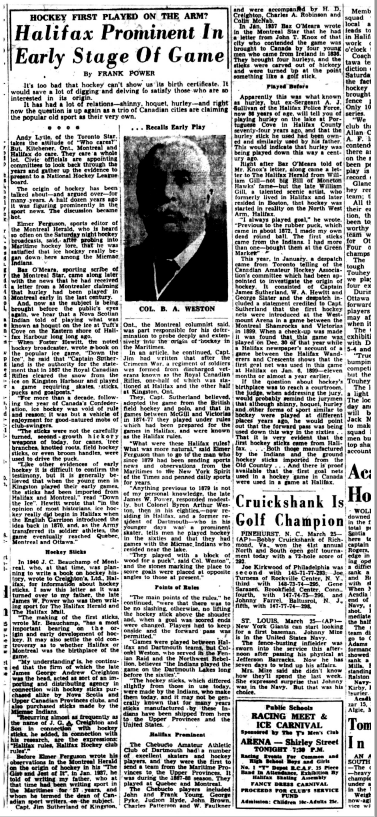
Since 1943, around eighty years ago now, hockey historians have known of Byron Weston’s “Halifax rules” of ice hockey. They are generally shown in list form only, and usally incorrectly, by the way. See for yourself. The source material, which is very important, is a newspaper article from the March 26 1943 edition of the Halifax Herald.
In a previous essay we argued that Weston’s 1860s Halifax rules must be regarded as a precursor to James Creighton’s Montreal rules of 1877, owing to Weston’s and Creighton’s extremely close childhood relationship which began at the early age of ten. Then we showed how this Halifax-to-Montreal legislative connection played out in relation to modern Ice Hockey, through the 1877 Montreal Rule’s relationship to the 1886 founding of the Amateur Hockey Association of Canada (AHAC) Ice Hockey’s first league.
All of this hearkens back to one of several reasons why the the March 26, 1943 article is a very important historical document.
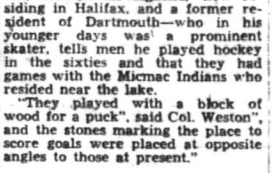
Another reason for the March 26 article’s importance is that Byron Weston affirmed playing with the members of the local First Nation Mi’kmaw players:
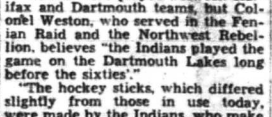
Then Weston adds more detail, informing us that Mi’kmaq hockey was a thing “long before the sixties”…
It couldn’t have been much later, when one of the Mi’kmaw players, Joe Cope, affirmed Weston’s statement. We believe that the follow up letter was sent to the same newspaper although it may have been the Halifax Mail. The dating Cope mentions in the passage below “the 26th” suggests a speedy reply on his part, as the Weston article clearly shows March 26, 1943. The second part of the passage below is the one most widely quoted part of the passage. The rest of Cope’s letter is generally ignored.
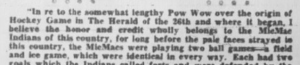
The uncomfortable truth is that Joe Cope completes the second paragraph by saying that this was a “batless” game. In doing so he seems to rule out a hockey stick categorically.
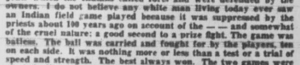
I’m guessing that this is why people only quote the first part of this passage. The rest makes them too uncomfortable to sort out, as the game Joe Cope writes about is clearly not “hockey.”
All of this is reconcilable, however, if one considers Joe Cope’s letter as a whole. The first paragraph turns out to be about a different kind of game. This distinction is made at the start of the second of the two paragraphs, where Cope differentiates the game he just discussed from skateless “hockey.”
“My father saw this [game] and ‘skateless hockey” more than a hundred years ago [100 years before 1943].
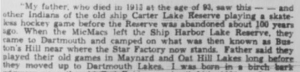
Cope’s elaboration on how the Mi’kmaq games migrated seems like a way of explaining what Weston alluded to on the 26th. My main takeaway, however, has long been that Joe Cope was almost certainly referring to two different Mi’kmaq games in his reply to Byron Weston’s comments.
This was affirmed by a recent discovery I made in 2023, when I found a letter that Thomas Raddall had written to a dentist in 1954, regarding early references to hockey. Raddall mentioned the writings of one Silas Tertius Rand, among others. On page 181 of Rand’s book, Legends of the Micmacs 1888, I found a references to two Mi’kmaw games. As the passage below will attest, the first is very similar to the first game Cope described, with the second also being a very direct reference to Mi’kmaq “hockey”.
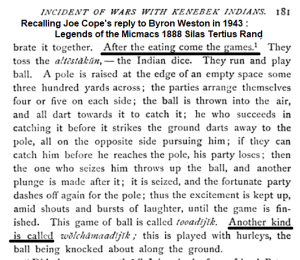
This is further evidence that the Mi’kmaw played at least two very different types of Mi’kmaq games. And that really should be kept in mind (rather than swept under the rug) when it comes to Joe Cope’s 1943 reply to Byron Weston.
Thinking of Weston and Cope matters, in other words. It does so for much the same reason that it matters that one consider Weston’s Halifax rules alongside Creighton’s Montreal rules.
Finally then, in Cope’s case we have more than mere affirmation that the indigenous Mi’kmaw played hockey with Weston, Creighton “and the others”…. We also have another question to ask, which has gone too long ignored:
Should Weston’s Halifax rules be amended to also include 10-player teams?
At the very least, this is something that should be mentioned in the same breath, now that Joe Cope’s very close playing relationship to Byron Weston is put front and centre.
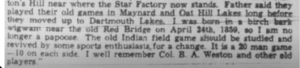
The only mystery is if Joe Cope was referring to the first game he mentioned. Unlikely, since that game went extinct before Weston (1850) and Creighton (1859) were born, around 1843. Unlikely, we say, also since Cope shifted subjects in the second paragraph, to the “hockey” gamem while linking Weston and 10-team hockey in the same breath. Here’s the text to consider.
 The Four Stars of Early Ice Hockey